India
India
 Singapore
Enterprise SMS in India: The Complete Guide to Reliable, Compliant Messaging at Scale
-
 By Smartping
- Sep 28, 2026
- SMS
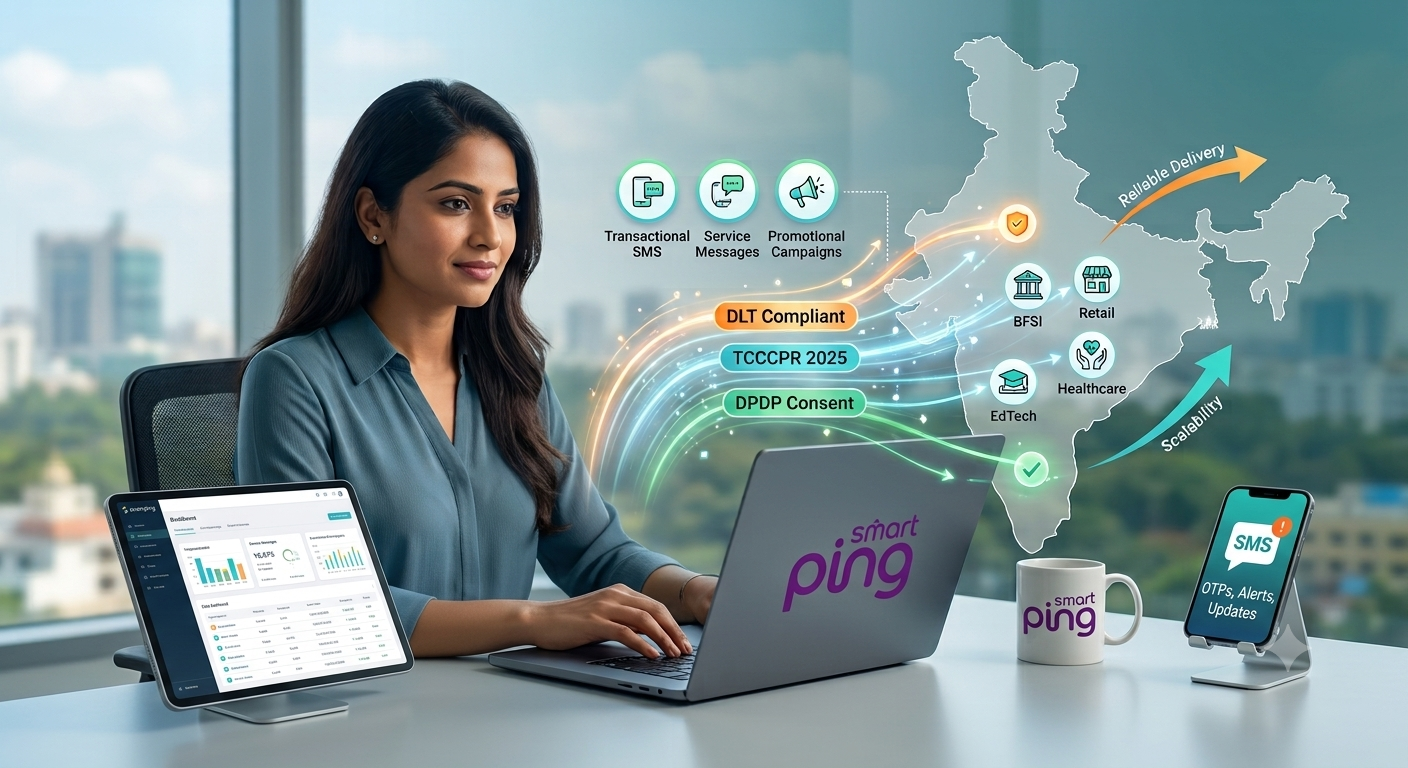
Enterprise SMS is the messaging layer behind India’s most critical customer communication. Payment confirmations, one-time passwords, account alerts, delivery updates and appointment reminders all depend on it. These messages carry operational and regulatory weight, and they are expected to arrive within seconds, every time.
For enterprises operating at scale, SMS is infrastructure. It connects core systems to customers across every operator and every handset, and it does so within a regulatory framework that governs sender identity, message content and customer consent.
This guide sets out how enterprise SMS works in India today. It covers message categories, the delivery architecture, DLT compliance, the latest TRAI regulations, consent obligations under the DPDP Act, industry use cases and the metrics that indicate whether an SMS programme is performing as intended.
Enterprise SMS Explained: The Channel Behind India’s Most Critical Customer Moments
Enterprise SMS, also known as Application-to-Person (A2P) messaging, refers to messages sent by a business system to a customer’s mobile number. These messages are triggered by applications such as banking platforms, e-commerce systems, CRMs, hospital information systems and marketing automation tools.
Unlike person-to-person texting, enterprise SMS operates at volume. A bank may send millions of transaction alerts in a single day. A retailer may send order updates to lakhs of customers during a sale period. A government department may need to reach citizens across Tier 2 and Tier 3 regions within hours.
Three characteristics define the channel for enterprise use:
1. Universal reach: SMS works on smartphones and feature phones alike, across every operator.
2. Network-level delivery: Messages are delivered without dependence on mobile data, applications or account creation.
3. Regulated and accountable: India’s DLT framework ties every message to a registered sender, header and template, creating a traceable communication trail.
The Enterprise Standard for SMS
At enterprise volumes, the requirement extends well beyond sending. It includes route quality, message prioritisation, compliance tooling, reporting accuracy, security and support commitments.
An enterprise-grade SMS platform is built around outcomes: the message reaches the right customer, within the expected time, in compliance with Indian regulations, with a verifiable record of what happened. Every element of the platform, from routing to reporting, exists to support that outcome.
SMS Within the Enterprise Communication Stack
Enterprise communication today spans SMS, WhatsApp, RCS, email and voice. Each channel serves distinct purposes within the customer journey, and enterprises typically operate several of them together.
SMS operates at the network level, which makes it suitable for authentication and time-critical alerts, and allows it to act as a technical fallback path when a message cannot be delivered through another channel. Orchestration across channels ensures each message is sent through the channel best suited to it, with defined fallback rules.
The Message Types Every Enterprise Needs to Get Right
In India, business messages fall into distinct categories. Each is governed by different rules, carries different expectations and should be handled separately within an enterprise’s messaging architecture.
Transactional Messages: OTPs, Payment Confirmations and Order Alerts
Transactional messages are triggered by an action the customer has taken. Examples include OTPs for login or payment, debit and credit alerts, and order confirmations. These messages are time-sensitive. An OTP that arrives after the session has expired has failed its purpose.
Service Messages: Updates, Reminders and Follow-Ups
Service messages keep customers informed about an ongoing relationship with the business. Examples include appointment reminders, policy renewal notices, delivery updates and account statements. They are sent with the customer’s consent and support the customer journey after the initial transaction.
Promotional Messages: Offers and Campaigns
Promotional messages carry offers, product announcements and campaign communication. They are subject to Do Not Disturb (DND) preferences, permitted time windows and consent requirements. Campaign traffic should be planned so that it never competes with critical transactional traffic.
The 30-Minute Transactional Window Under TCCCPR 2025
TRAI’s 2025 amendments to the Telecom Commercial Communications Customer Preference Regulations (TCCCPR) tightened the definition of a transactional message. A message now qualifies as transactional only when it is triggered by a customer-initiated transaction and sent within 30 minutes of that transaction.
This has a direct impact on template design. Messages previously treated as transactional, such as delivery updates sent hours after an order or reminders sent days later, may now need to be classified as service messages. The amendments also introduced category suffixes on sender headers, making the message type visible to the recipient.
Enterprises should review existing templates against this rule, map every message to its correct category and register templates accordingly.
Inside the Delivery Architecture: From API Call to Customer Handset
Every enterprise SMS follows a defined path. Understanding that path helps teams identify where delays and failures occur, and how they can be prevented.
Flow: Enterprise System (CRM, core banking, e-commerce) → SMS API → Scrubbing and Validation → DLT Verification → Operator Route → Customer Handset → Delivery Report
Each stage adds a layer of control. A message that passes through all of them reaches the customer quickly, correctly and in compliance.
Priority Routing and Direct Operator Connectivity
Not every message carries equal urgency. An OTP must reach the customer in seconds. A campaign message can tolerate a short delay.
Enterprise SMS platforms separate traffic by priority, so authentication and payment messages move ahead of campaign volumes. This matters most during peak periods such as sale events, salary cycles and festive seasons, when campaign volumes rise sharply. Direct connectivity with operators reduces the number of hops a message travels, improving speed and reliability.
SMS Scrubbing and Data Quality
Sending messages to invalid, duplicate or restricted numbers affects delivery performance and distorts reporting. SMS scrubbing validates destination numbers before messages are sent, removing invalid entries, duplicates and numbers that should not receive a particular category of message.
Clean data produces accurate delivery rates and reliable campaign analysis. For enterprises sending millions of messages, data quality is an operational discipline, not a one-time exercise.
Delivery Reports That Reflect Real Outcomes
A delivery report (DLR) confirms whether a message reached the handset. For enterprises, DLRs are more than a technical acknowledgement. They reveal delivery latency, failure reasons and operator-level performance.
Read correctly, DLR data identifies issues that would otherwise remain invisible: OTPs failing on a specific operator, alerts delayed during peak hours, or campaigns reaching fewer customers than planned. Accurate, real-time reporting is essential for any enterprise that treats SMS as critical infrastructure.
DLT Compliance in India: Registration, Templates and Sender IDs
India’s Distributed Ledger Technology (DLT) framework governs all commercial SMS. It creates a verified link between the sending entity, the sender ID (header), the message template and the customer’s consent.
Entity, Header and Template Registration
DLT compliance involves three core registrations:
1. Entity registration: The business registers itself on an operator’s DLT platform with its legal and identity documents.
2. Header registration: The sender ID that customers see is registered and linked to the entity.
3. Template registration: Every message format, including its fixed content and variable fields, is registered and approved before use.
Responsibility for these registrations often spans marketing, IT and compliance teams. Clear ownership prevents delays, particularly ahead of large campaigns.
Whitelisted URLs, APKs and Callback Numbers
TRAI requires that URLs, APK links, OTT links and callback numbers included in messages are whitelisted. Messages containing unregistered links or numbers are blocked. Enterprises should maintain an updated register of approved links and ensure campaign teams use only whitelisted destinations.
Common Reasons Templates Get Rejected
Template rejection is one of the most frequent causes of campaign delay. Common reasons include:
1. Variable fields used for content that should be fixed.
2. A mismatch between the template category and its content.
3. Unregistered URLs or callback numbers.
4. Promotional language inside a transactional or service template.
A pre-submission checklist, reviewed by both marketing and compliance, significantly reduces rejection rates.
Consent and Data Privacy: TRAI Digital Consent and the DPDP Act
Consent sits at the centre of enterprise messaging in India. Two separate frameworks now govern it, and enterprises need to address both.
Two Consents, Two Purposes
The Digital Personal Data Protection (DPDP) Act governs how personal data is collected and processed. TRAI’s regulations govern commercial communication, including customer preferences and digital consent acquisition for messages.
The two are not interchangeable. Consent obtained under the DPDP Act does not automatically validate commercial communication under TCCCPR. Enterprises need to capture and record both, with clear purpose statements and a straightforward way for customers to withdraw consent.
Key Dates for Enterprise Teams: 13 November 2026 and 13 May 2027
The DPDP Rules introduce a phased timeline. The Consent Manager framework becomes operational on 13 November 2026, and full compliance obligations apply from 13 May 2027.
Ahead of these dates, enterprises should:
1. Audit existing contact lists and the consent records attached to them.
2. Separate DPDP consent from TRAI commercial communication consent.
3. Update consent capture across websites, apps, forms and offline touchpoints.
4. Define retention periods and withdrawal processes.
5. Align messaging platforms and CRMs so consent status travels with every message.
Enterprise SMS Use Cases Across Industries
BFSI and Fintech
Banks, NBFCs, insurers and fintech platforms use SMS for OTPs, transaction alerts, EMI reminders, KYC updates and fraud warnings. Delivery speed and regulatory accuracy are equally critical.
Retail and E-commerce
Retailers use SMS for order confirmations, shipping updates, delivery windows, back-in-stock alerts and campaign communication. During sale events, volumes can multiply within hours, making priority routing essential.
Healthcare
Hospitals, diagnostic centres and clinics use SMS for appointment reminders, report availability, prescription refills and follow-up care. Reliable reminders reduce no-shows and support continuity of care.
Automotive, Travel and Logistics
Automotive brands send service reminders and booking confirmations. Travel companies share tickets, itinerary changes and check-in alerts. Logistics providers communicate delivery windows, OTP-based handovers and failed-delivery notices.
EdTech and Government
Education providers use SMS for admission updates, fee reminders and class schedules. Government departments use SMS to reach citizens with scheme information, service updates and alerts, particularly where smartphone penetration and data access remain limited.
Personalisation and Multilingual Messaging at Scale
Relevance drives response. Customers engage more with messages that reflect their name, their transaction and their language.
Regional-Language and Unicode Templates
India’s linguistic diversity makes regional-language messaging an operational requirement. Unicode SMS supports Indian scripts and changes character limits per message segment, and templates in each language must be registered separately under DLT. Language coverage should be planned early, particularly ahead of regional campaigns.
Dynamic Variables Within DLT Rules
Personalisation in SMS works through registered variable fields: names, amounts, dates, order numbers and links. These must be used within the rules of the approved template. Designed well, a single template can deliver thousands of personalised messages while remaining fully compliant.
Securing OTP and Authentication Traffic
OTP messages protect customer accounts and transactions. They are also a frequent target for misuse.
Fraud Signals and Artificial Traffic
Artificially inflated traffic, often called SMS pumping, occurs when automated scripts trigger large volumes of OTP requests to numbers controlled by fraudsters. This distorts messaging operations and can mask attempts to compromise accounts.
Enterprises can reduce this risk through:
1. Rate limits on OTP requests per user, device and number range.
2. Monitoring for unusual request patterns by geography or time.
3. Route-level analytics to detect abnormal delivery behaviour.
4. Alternative authentication methods for high-risk scenarios.
Multichannel Authentication and Fallback Paths
Many enterprises deliver authentication and alerts across more than one channel, with defined fallback rules. When a message cannot be delivered through the primary channel, the fallback path ensures the customer still receives it. Designing these rules in advance protects critical communication regardless of device or network conditions.
Measuring SMS Performance: The Metrics That Matter
Sending a message is only the beginning. Enterprises need visibility into what happens after it leaves their systems. Key metrics include:
1. Delivery rate: The percentage of messages successfully delivered to handsets.
2. Delivery latency: The time between the API request and delivery, which is critical for OTPs.
3. Failure analysis: Failure codes by operator, region and template.
4. Click-through rate: For messages that include links.
5. Conversion and resolution: Payments completed, appointments attended or queries resolved.
6. Operational quality: Template approval turnaround, incident response times and reporting accuracy.
When these metrics are linked to business systems, SMS performance becomes measurable in terms of customer outcomes rather than message volumes.
Choosing an Enterprise SMS Provider: An Evaluation Checklist
The right provider becomes part of an enterprise’s critical infrastructure. When evaluating options, consider:
1. Route quality and operator connectivity: Direct connections and priority routing for critical traffic.
2. DLT support: Guidance on registration, templates and approvals.
3. Data quality tools: Built-in scrubbing and number validation.
4. Reporting: Real-time, accurate delivery reports with failure analysis.
5. Scalability: Proven capacity during peak volumes.
6. API and integrations: Clear documentation and connectors for CRMs and enterprise systems.
7. Security and certifications: Data protection practices, infrastructure standards and compliance readiness.
8. Omnichannel capability: Orchestration of SMS alongside WhatsApp, RCS, email and voice.
9. Support: Responsive, accountable support with defined service levels.
Enterprise SMS With Smartping
Smartping helps enterprises deliver critical communication with speed, accuracy and compliance at scale.
With its own DLT platform and SMS scrubbing node, Smartping gives enterprises greater control over registration, data quality and delivery. Its programmable SMS API connects directly with enterprise systems, priority routing keeps OTPs and transactional messages moving even when campaign volumes rise, and real-time delivery reports give teams an accurate view of what reached customers and what did not.
Through SPARC, Smartping’s omnichannel platform, SMS operates alongside WhatsApp, RCS, email and voice, with orchestration and fallback rules across channels.
Smartping serves 3,000+ customers and processes 100 billion+ messages annually. Enterprises across BFSI, retail, healthcare, automotive, education and government rely on Smartping for the communication moments that matter. In one engagement, a financial services provider achieved 6x faster campaign execution.
Schedule a demo at smartping.ai to see how Smartping can support your enterprise messaging.
Frequently Asked Questions
1. Is DLT registration mandatory for all business SMS in India?
Yes. Every business sending commercial SMS in India must register its entity, sender headers and message templates on an operator’s DLT platform. Messages from unregistered entities, headers or templates are blocked before delivery.
2. Can transactional SMS reach customers registered on DND?
Transactional messages, such as OTPs and payment alerts triggered by a customer’s own action, can be delivered to DND-registered numbers. Under TCCCPR 2025, they must be sent within 30 minutes of the customer-initiated transaction to qualify as transactional.
3. Does SMS work without mobile internet?
Yes. SMS is delivered through the mobile network rather than the internet. It reaches smartphones and feature phones alike, even when the customer has no data connection, which makes it dependable for critical alerts.
4. Can one platform handle OTP, service and promotional SMS together?
Yes. An enterprise SMS platform can manage all message categories from a single system while keeping them on separate routes and priorities, so critical messages are never delayed by campaign traffic.
5. Is consent under the DPDP Act enough for promotional SMS?
No. DPDP consent covers the processing of personal data. Promotional messages also require consent under TRAI’s commercial communication regulations. Enterprises should capture and record both separately.
Enable businesses to forge enduring connections with their customers through multiple channels.
Latest Blogs
-
WhatsApp Business API: A Complete Guide for Enterprises
Customer interactions rarely stay on one channel. A customer discovers a product through an ad, evaluates it on a website,...
Read More
-
One Channel, Complete Customer Journey: How WhatsApp Business API Improves Engagement and Drives ROI
Most enterprises handle customer interactions across multiple channels. A customer might discover your product through a click-through ad on one...
Read More
-
x
Enterprise SMS in India: The Complete Guide to Reliable, Compliant Messaging at Scale
Read More
Share


Related Blogs & Articles

WhatsApp Business API: A Complete Guide for Enterprises
Customer interactions rarely stay on one channel. A customer discovers a product through an ad, evaluates it on a website,...

One Channel, Complete Customer Journey: How WhatsApp Business API Improves Engagement and Drives ROI
Most enterprises handle customer interactions across multiple channels. A customer might discover your product through a click-through ad on one...

x
Enterprise SMS in India: The Complete Guide to Reliable, Compliant Messaging at Scale
x
Enterprise SMS in India: The Complete Guide to Reliable, Compliant Messaging at Scale




 First Floor, Unit F-49, Sector-47, Spaze Boulevard, Gurugram, Haryana 122018