


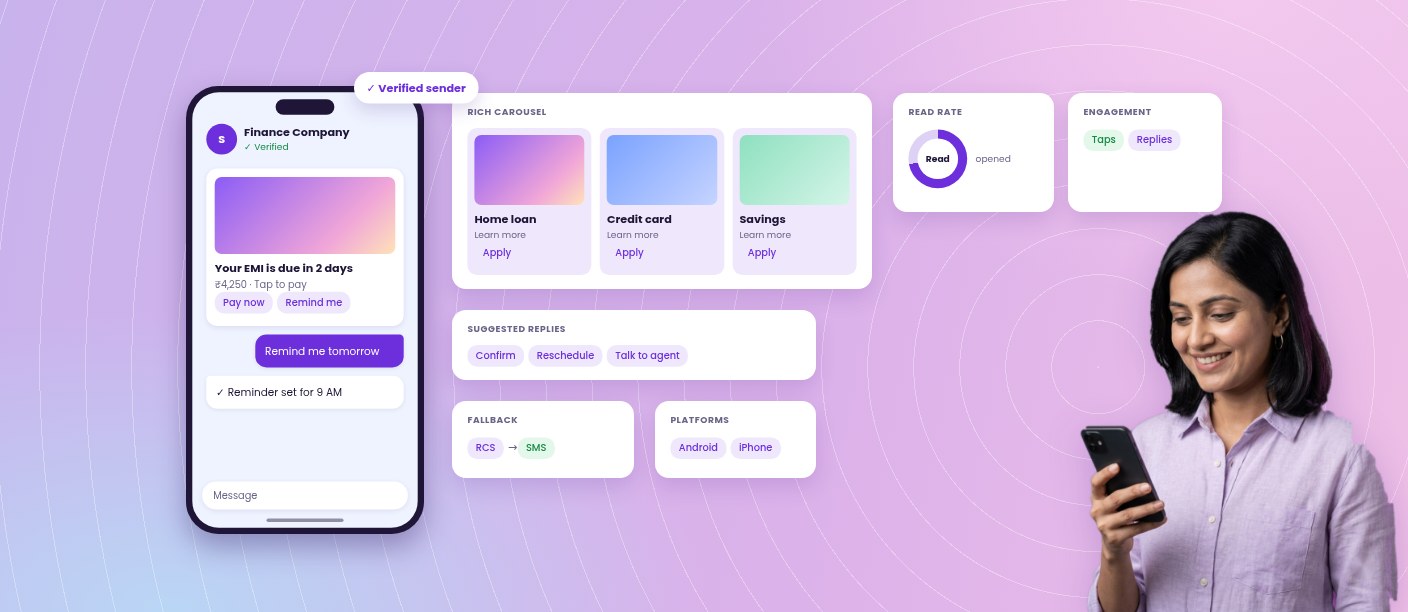
Rich Communication Services (RCS) is the messaging standard that brings branded, interactive experiences to the native messaging inbox on a mobile device. RCS Business Messaging (RBM) is its enterprise implementation, allowing verified brands to send rich content, interactive actions and two-way conversations without requiring customers to install an application.
In India, RCS reached an important stage of maturity in 2026. All three major operators support RBM, and iPhone users became reachable through Jio’s commercial launch in September 2026. For enterprises operating at scale, RCS is now a practical channel for high-volume, brand-verified communication.
This guide sets out how RCS works, the current reach landscape in India, the rich features available to enterprises, how to register and launch an RCS programme, how fallback operates, and how performance is measured.
RCS Business Messaging Explained
RCS Business Messaging allows enterprises to send messages to a customer’s default messaging application with the brand’s verified identity attached. An RCS message can include:
1. The brand’s verified name, logo and verification indicator.
2. Images, video and animated content.
3. Rich cards and scrollable carousels.
4. Suggested replies and action buttons.
5. Location sharing, calendar actions and deep links.
Because these messages arrive in the default inbox, customers receive them without downloading an application, creating an account or changing their behaviour.
The Native Inbox Environment
RCS content renders inside the messaging application already present on the device. This shapes design decisions: content must be concise, actions must be immediately visible, and each message should have a single clear purpose. Journeys should be built around a specific customer goal, such as tracking an order or booking an appointment, with content designed for the inbox environment.
RCS in India Today: Operators, Devices and iPhone Reach
Enterprise planning begins with reach.
Jio, Airtel and Vi Coverage
Jio, Airtel and Vi all support RCS Business Messaging. Most modern Android smartphones with a supported messaging application can receive RCS, giving enterprises access to a large and growing base of customers.
iPhone Support Through Jio (September 2026)
In September 2026, Jio introduced commercial RCS Business Messaging for iPhone users. This extends rich messaging to a customer segment previously reachable only through other channels.
For enterprises, this changes audience planning. Campaigns can now include iPhone users on Jio, and creative should be validated to ensure it renders correctly across both platforms.
Capability Checks and Reach Planning
Availability depends on device, operator, application version and settings. Enterprises should run capability checks before sending and design every RCS journey with a fallback path, so no customer misses a message.
Rich Features Available to Enterprises
Verified Sender Identity and Branding
Every RCS business message displays the brand’s name, logo and verification status. Customers can confirm the source of the message at a glance, which supports trust and makes impersonation considerably harder.
Rich Cards and Carousels
Rich cards combine an image, a title, a description and action buttons in a single message. Carousels place several cards side by side, allowing customers to browse products, plans, offers or service options by scrolling within the conversation.
Suggested Replies and Action Buttons
Suggested replies allow customers to respond with a single tap rather than typing. Action buttons can open a website, dial a number, share a location or add an event to a calendar, reducing the number of steps between interest and action.
Media, Location and Calendar Actions
RCS supports high-quality images and video, location sharing and calendar actions. An automotive brand can share a model walkthrough with a test-drive booking action. A travel brand can share a boarding pass with directions to the terminal. A hospital can confirm an appointment with a calendar action.
RCS Message Types and Agent Structure
Enterprises use RCS across the full range of communication: authentication, transactional alerts, campaign messages and two-way conversations.
Separate Agents for Separate Workloads
RCS messages are sent through registered agents that represent the brand. Operating separate agents for different workloads, for example one for authentication and transactional alerts and another for campaign communication, keeps critical traffic isolated and makes performance monitoring clearer.
Brand Assets and Agent Profiles
Each agent carries brand assets: logo, banner, description, contact details and website. These assets appear in the customer’s inbox, so they should be prepared to specification and reviewed by the brand team before submission.
Building an RCS Programme: From Verification to Launch
Flow: Brand and Agent Registration → Verification → Journey and Template Design → Testing → Launch With Fallback → Analytics and Optimisation
Agent Registration and Brand Verification
Enterprises register an RCS agent with brand details, assets and contact information. The agent is verified before it can send messages. Planning this stage early prevents delays ahead of campaign launches.
Journey and Template Design
Effective RCS journeys are short and action-led. Each message should carry one purpose and one clear next step, designed around a customer goal rather than adapted from an existing message format.
Testing Before Launch
Rich content behaves differently across devices, screen sizes and platforms. Testing on simulated devices and physical handsets before launch confirms that images, carousels and buttons render correctly and that every action performs as intended.
Fallback for Non-RCS Devices
When a customer’s device or network does not support RCS, the message is delivered through the fallback path configured for that campaign. A well-designed fallback preserves the core message and the required action, so one campaign reaches every intended customer.
Conversational RCS: Chatbots and Two-Way Service
RCS supports two-way conversations. Paired with chatbots, enterprises can answer questions, collect information, reschedule appointments and process returns within the messaging thread. Suggested replies guide customers through each step, and conversations can be escalated to human agents when required.
RCS Use Cases Across Industries
Retail and E-commerce
Product carousels for discovery, cart reminders with visuals, order tracking cards and delivery updates within the native inbox.
Automotive
Model launches with video, test-drive booking actions, service reminders and dealership communication that converts interest into visits.
BFSI and Fintech
Verified account alerts, card communication, KYC reminders and payment confirmations, delivered with visible brand identity.
Travel, Healthcare and EdTech
Boarding passes, itinerary updates and disruption alerts; appointment confirmations and report notifications; admission guidance delivered as interactive steps.
Logistics and Government
Delivery scheduling with address confirmation, and citizen communication with verified sender identity for scheme and service updates.
Measuring RCS Performance
RCS provides interaction-level visibility. Enterprises can measure:
1. Delivery: Whether the message was delivered as RCS or through the fallback path.
2. Read receipts: Whether the customer opened the message.
3. Interactions: Taps on suggested replies, action buttons and carousel cards.
4. Journey completion: Bookings, confirmations or purchases completed after the interaction.
5. Rendering quality: Whether rich content displayed correctly across devices.
These signals show precisely where customers engage and where journeys break, allowing teams to refine content continuously.
Security and Fraud Protection With Verified Senders
Messages impersonating banks, delivery companies and government bodies are a recognised concern in India. RCS addresses this through verified sender identity. Customers see the brand logo and verification status, which makes genuine messages easier to recognise and fraudulent ones easier to question.
For BFSI, logistics and government communication, verified sender identity is a practical customer protection measure, alongside its role in engagement.
Governance and Content Approval
RCS content carries the brand’s verified identity, so governance matters. Enterprises should define who approves templates and assets, maintain a library of approved journeys, keep a record of active agents and review campaign content against regulatory and brand guidelines before submission.
Operational Readiness Before Launch
An RCS programme depends on preparation that sits outside the messaging platform itself.
1. Data readiness: Accurate mobile numbers, consent records and customer attributes used for personalisation.
2. Segmentation: Clear audience definitions, including device and operator capability, so journeys are sent to customers who can act on them.
3. Content inventory: Approved images, video, copy and action links, prepared to the required specifications.
4. System integration: Connections to CRM, order management or booking systems, so messages carry live data and customer actions update enterprise records.
5. Escalation paths: Defined routes for customers who reply with questions, including chatbot flows and agent handoff.
Enterprises that complete this groundwork before registration move from verification to live campaigns without delay.
Integration With Enterprise Systems
RCS journeys reach their full value when connected to enterprise systems through APIs. Order management systems can trigger tracking cards at each stage of fulfilment. Booking systems can send confirmations with calendar actions. Service platforms can send status updates with reply options that update the ticket directly.
Two-way integration matters equally. When a customer taps an action, the response should be recorded against the customer profile, so subsequent communication reflects what has already happened.
Team Roles and Ownership
An RCS programme usually involves several teams: brand for assets and tone, marketing for journeys and audiences, IT for integration and data, compliance for content review, and customer service for escalations. Assigning ownership for each stage, from agent registration through to performance review, keeps programmes running predictably once volumes increase.
Common Implementation Challenges
Enterprises adopting RCS encounter a consistent set of practical issues, each of which can be planned for.
1. Asset quality: Logos and images that do not meet specification are rejected or render poorly. Prepare assets to the required dimensions and formats before submission.
2. Overlong journeys: Messages that carry too many actions reduce response. Keep each message to one purpose and one primary action.
3. Fragmented ownership: Brand, marketing, IT and compliance each hold part of the process. Agree ownership and approval steps before registration.
4. Inconsistent data: Personalisation fails when customer records are incomplete. Validate the fields used in each journey.
5. Unplanned fallback: Campaigns designed only for RCS leave part of the audience uncontacted. Configure and test the fallback path for every journey.
6. Limited testing: Rendering differs across devices. Test on simulated devices and physical handsets before every major launch.
Content Standards for Rich Messaging
Because RCS messages carry verified brand identity, content standards should be documented and applied consistently. These typically cover approved tone and terminology, image and video specifications, rules for action button labels, requirements for accessibility such as descriptive text, guidance on message frequency, and mandatory elements for regulated communication. A documented standard allows campaign teams to produce content quickly while keeping the brand presentation consistent across every journey.
Choosing an RCS Partner: An Evaluation Checklist
1. Operator connectivity: Direct integrations across Indian operators.
2. Verification support: Guidance through agent registration and brand verification.
3. Testing tools: Device simulation and pre-launch validation.
4. Fallback management: Configurable fallback paths with consistent reporting.
5. Workload separation: Support for multiple agents across message types.
6. Analytics: Delivery, read and interaction data in real time.
7. Chatbot integration: Support for two-way conversational journeys.
8. Omnichannel capability: Orchestration with SMS, WhatsApp, email and voice.
RCS Business Messaging With Smartping
Smartping helps enterprises launch and scale RCS Business Messaging with operational control.
Smartping connects enterprises to RCS across Indian operators and supports them through agent registration and brand verification. Device simulation and testing tools allow teams to validate journeys before launch. Separate agents keep authentication and transactional traffic apart from campaign communication, and configurable fallback ensures every customer receives the message. Real-time analytics report delivery, read and interaction data.
Through SPARC, RCS operates alongside SMS, WhatsApp, email and voice as part of one connected customer journey.
Schedule a demo at smartping.ai to see how Smartping can support your RCS programme.
Frequently Asked Questions
1. Is RCS available on all Android phones in India?
RCS is available on most modern Android smartphones using a supported messaging application across Jio, Airtel and Vi. Availability also depends on device settings and application version.
2. Can iPhone users receive RCS business messages in India?
Yes. Since September 2026, Jio supports RCS Business Messaging for iPhone users. Enterprises should confirm availability across other operators and configure fallback for customers who cannot receive RCS.
3. Do customers need an app to receive RCS messages?
No. RCS messages arrive in the device’s default messaging application. Customers do not need to download an application or create an account.
4. Do enterprises need separate RCS agents for different message types?
It is recommended. Separate agents for authentication, transactional and campaign communication keep critical traffic isolated and make performance monitoring and governance clearer.
5. How long does RCS brand verification take?
Timelines vary by operator and the completeness of the submitted brand assets. Enterprises should begin registration well before a planned campaign and prepare logos, descriptions and contact details to specification.