India
 Singapore
AI Voicebot: A Complete Guide for Enterprises
-
 By Smartping
- Oct 05, 2026
- Voicebot
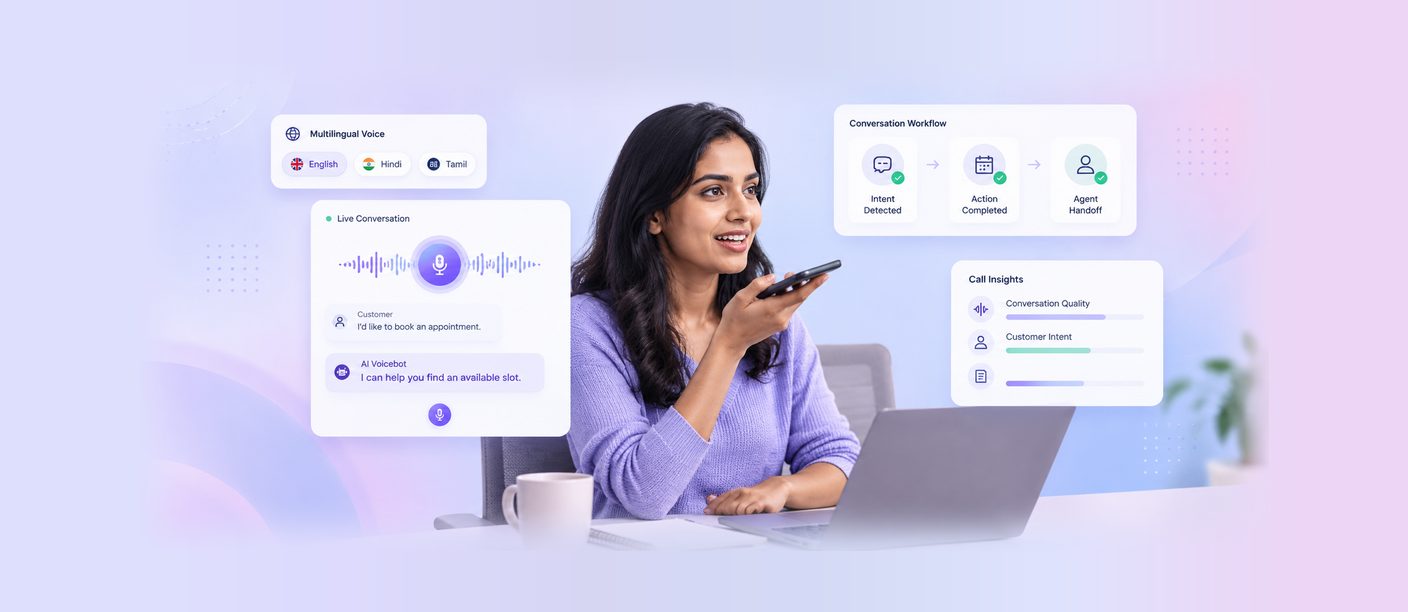
Table of Contents
- 1. From IVR Menus to AI Voice Agents: What Has Changed
- 2. How an AI Voicebot Works
- 3. AI Voicebot vs Traditional IVR vs Chatbot
- 4. Business Benefits of an AI Voicebot
- 5. AI Voicebot Use Cases
- 6. Multilingual Voicebots: Why Language Handling Matters
- 7. Integration Architecture
- 8. Human Handoff: Where the Bot Stops and the Agent Starts
- 9. Implementation Roadmap
- 10. Compliance, Consent and Data Protection
- 11. How to Choose an AI Voicebot Platform: Evaluation Checklist
- 12. Measuring Voicebot Performance
- 13. AI Voicebot With Smartping
- 14. Frequently Asked Questions
Voice is becoming the busiest channel for automation. Gartner predicted that conversational AI would cut contact centre agent labour costs by as much as $80 billion in 2026, and that one in every ten agent interactions would be automated by then, up from 1.6% when the forecast was made in 2022.
Spending is following the results. Meticulous Research values the global voice AI agents market at USD 3.40 billion in 2025, rising to USD 5.10 billion in 2026 and a projected USD 43.83 billion by 2036, a compound annual growth rate of 24%. In India, large consumer businesses already run voice AI at scale: Meesho’s generative AI voice agent handles around 60,000 customer calls a day in English and Hindi.
This guide covers how AI voicebots work, the measurable outcomes enterprises report in customer support, lead conversion, sales and EMI collections, how voicebots fit into enterprise systems, what compliance requires and how to evaluate a platform.
From IVR Menus to AI Voice Agents: What Has Changed
Three shifts explain the growth. Large language models (LLMs) let voicebots handle open-ended questions and interruptions instead of fixed menus such as “press 1 for billing”. Speech recognition now copes with regional accents and code-mixed Hindi and English. And voice remains the channel customers choose when an issue is urgent or complex, while also being the most expensive channel to staff.
On every call, a modern enterprise voicebot does five things:
1. Converts the caller’s speech to text in real time.
2. Identifies intent and extracts details such as dates, amounts and account references.
3. Fetches the answer from connected systems or an approved knowledge base.
4. Converts the response back into natural speech.
5. Acts, by booking an appointment, logging a request, sending a link or transferring to an agent.
How an AI Voicebot Works
A voicebot is a pipeline of components working together to understand and respond to callers in real time.
Automatic Speech Recognition (ASR / STT): Converts speech into text, including accents, background noise and code-mixed language.
Language understanding (NLU and LLM): Identifies intent, maintains context and understands industry-specific terms such as EMI or policy numbers.
Dialogue management: Determines whether to clarify, answer, perform an action or escalate the call.
Knowledge and system integration: Retrieves current information from CRMs, product databases and enterprise systems through APIs.
Text-to-Speech (TTS): Converts responses into natural speech, with control over speed, pitch and voice modulation.
Telephony layer: Connects, routes and manages calls, including concurrent conversations.
AI Voicebot vs Traditional IVR vs Chatbot
| Feature | Traditional IVR | Text Chatbot | AI Voicebot |
|---|---|---|---|
| Input | Keypad or fixed phrases | Typed text | Natural speech |
| Conversation style | Menu-driven | Flow or LLM-driven | Open-ended, context-aware |
| Handles interruptions | No | Not applicable | Yes |
| Language flexibility | Limited, one language per menu | Depends on build | Switches languages mid-call |
| Typical outcome | Routes the call | Answers in text | Resolves, qualifies or routes the call |
An IVR routes callers. A voicebot can resolve the request itself and route to a human only when needed.
Business Benefits of an AI Voicebot
Availability at scale: Handles high call volumes simultaneously, including outside business hours, reducing queues during peak periods.
Lower cost to serve: Automating repetitive calls reduces dependence on large agent teams for routine queries and shortens training cycles.
Higher agent productivity and faster resolution: By resolving simple requests and qualifying callers, the voicebot allows agents to focus on complex conversations without customers repeatedly explaining their issues.
Consistent experience and actionable insights: Provides policy-aligned responses while capturing customer intents, call outcomes and recurring service issues.
Smartping’s voicebot is positioned around outcomes such as an approximate 80% reduction in operational costs, up to 60% increase in CSAT scores, an approximate 30% increase in ROI and up to 20% improvement in agent productivity. Results depend on use case, call mix and deployment scope.
AI Voicebot Use Cases
Inbound
Customer support: An AI voicebot can retrieve order details, answer common questions and transfer unresolved issues to an agent. This reduces waiting times and helps businesses manage peak demand without proportionally increasing support costs.
Appointment booking: A voicebot connected to the booking system can check available slots, schedule appointments and process rescheduling requests around the clock. This reduces missed enquiries, saves administrative time and improves appointment coordination.
Lead capture and qualification: For example, a real estate developer can use a voicebot to engage new enquiries immediately, ask about budget, location and purchase timeline, and record responses in the CRM. Qualified prospects can then be routed to sales representatives.
Outbound
Payment reminders and EMI collections: An AI voicebot can automate permitted reminders, communicate payment details and capture repayment intentions. Complex disputes can be transferred to collection agents, reducing routine calling workloads.
Appointment and event reminders: A voicebot can call customers beforehand, confirm attendance and record rescheduling requests. This improves schedule utilisation while reducing manual follow-up efforts.
Feedback collection: For instance, an automotive service centre can use a voicebot to contact customers after vehicle servicing, collect satisfaction feedback and flag complaints for human follow-up. This helps identify service issues without dedicating employees to every survey call.
Lead follow-up: An EdTech company can use a voicebot to follow up with prospective students, ask about course interests and qualifications, and schedule counselling calls. This reduces follow-up delays and allows counsellors to prioritise interested applicants.
Multilingual Voicebots: Why Language Handling Matters
In India, customers frequently switch between languages or combine Hindi and English within the same conversation. A voicebot that cannot adapt may increase call abandonment.
A strong multilingual voicebot should detect language changes, understand regional accents and code-mixed speech, maintain conversation context and pronounce names, amounts and dates naturally.
When evaluating platforms, test these capabilities using actual telephony audio, regional accents and noisy conditions rather than relying only on studio-quality samples.
Integration Architecture
A voicebot delivers most of its value when connected to systems containing live customer information. Typical integrations include:
CRM: Customer identity, history and call logs.
Core business systems: Orders, policies, loans, bookings and inventory.
Payment systems: Payment links and confirmations.
Ticketing and helpdesk: Creating and updating customer requests.
Contact center platform: Transferring calls to agents with conversation context.
Analytics and BI tools: Tracking call outcomes and customer intents.
APIs and webhooks can trigger outbound calls following events such as missed payments, upcoming appointments or new leads. Consistent identity matching helps recognise returning customers across channels.
Human Handoff: Where the Bot Stops and the Agent Starts
Automation works best with clearly defined escalation rules. A voicebot should transfer calls when:
Intent: The request involves complaints, disputes or sensitive matters.
Low confidence: The bot repeatedly fails to understand the caller.
Sentiment: The caller expresses frustration or distress.
Customer request: The caller asks to speak with a person.
During handoff, the bot should pass the transcript, captured details and detected intent so customers do not have to repeat themselves.
Implementation Roadmap
1. Use case selection and conversation design: Identify high-volume call types, define objectives, required information, tone and escalation rules.
2. Knowledge preparation and integration: Prepare approved content and connect CRM, business systems and contact centre platforms.
3. Language and voice configuration: Configure supported languages, voice characteristics and pronunciation rules.
4. Testing and pilot: Test real-world accents, noise, interruptions and edge cases before launching on a limited share of calls.
5. Scale and optimisation: Monitor pilot performance, refine conversations and gradually expand to additional intents, languages and outbound campaigns.
Compliance, Consent and Data Protection
Voice interactions involve personal and sometimes financial data, so governance matters from the first deployment.
Disclosure: Tell callers they are speaking with an automated assistant.
Call recording consent: Inform customers when calls are recorded or transcribed.
Data protection: Handle personal data collected during calls in line with the DPDP Act. The Consent Manager framework becomes operational from 13 November 2026, with full compliance required from 13 May 2027.
Outbound calling rules: Observe telecom regulations and customer preferences on commercial calls, including registered preferences and permitted calling windows.
Data security: Apply access controls, encryption and defined retention periods to recordings and transcripts.
Auditability: Keep records of consent, call outcomes and escalations.
How to Choose an AI Voicebot Platform: Evaluation Checklist
| Criterion | What to Check |
|---|---|
| Language and conversation quality | Regional accents, interruptions, code-mixed speech, multilingual switching and open-ended conversations |
| Voice technology and customisation | TTS, STT and NLP capabilities, technology ownership and control over voice characteristics |
| Scale and reliability | Concurrent call capacity, telecom infrastructure, availability and SLA commitments |
| Integrations and handoff | CRM connectivity, open APIs, enterprise system integrations and context-rich agent transfers |
| Ease of management and analytics | No-code builders, prebuilt agents, real-time dashboards and conversation scoring |
| Compliance, support and deployment | Consent handling, data protection, auditability, dedicated support and time to go live |
Measuring Voicebot Performance
1. Containment rate: Share of calls resolved without agent involvement.
2. Task completion rate: Bookings made, payments confirmed and leads qualified.
3. Average handling time: Call duration by intent.
4. CSAT: Post-call satisfaction scores.
5. Escalation rate and quality: How often, why and how well context transfers.
6. Drop-off rate: Where in the flow callers abandon.
7. Agent productivity: Change in agent time spent on high-value conversations.
AI Voicebot With Smartping
Smartping’s Gen AI voicebot is built on LLM and NLU technology to automate voice interactions across customer support, sales and collections. It runs on an in-house voice stack covering TTS, STT, NLP and voice cloning, and supports mid-call language switching across 10+ languages.
Key capabilities include:
1. Handling over 10,000 concurrent calls with 24/7 availability.
2. A no-code flow builder with CRM, API and enterprise system integrations.
3. Real-time personalisation from CRMs, product databases and policy catalogues.
4. Lead qualification, intent routing and smart handoff to live agents.
5. Built-in analytics for call outcomes, drop-offs, CSAT and auto-scored conversations.
6. 100+ pre-trained agents across industries and use cases.
7. Dedicated success and SLA-driven support, with go-live in under 30 minutes.
Explore the Smartping Voice Bot and try the live demo experiences, or schedule a demo at smartping.ai to see how voice automation can fit your customer operations.
Frequently Asked Questions
1. What is an AI voicebot?
An AI voicebot is software that conducts spoken conversations with customers over phone calls. It uses speech recognition, language understanding and text-to-speech to understand requests, retrieve information and respond in natural speech, handing over to a human agent when needed.
2. How is an AI voicebot different from an IVR?
An IVR guides callers through fixed menus using keypad input or set phrases. An AI voicebot understands natural speech, handles open-ended questions and interruptions, and can complete tasks itself rather than only routing calls.
3. Can an AI voicebot handle multiple languages?
Yes. Advanced voicebots detect the customer’s language and switch between languages during the same call. Performance varies by platform, so test with your real customer languages, accents and code-mixed speech.
4. Is call recording allowed with a voicebot?
Recording and transcription are common, but customers should be informed, and recordings must be handled in line with the DPDP Act and applicable telecom rules. Define retention periods and access controls before launch.
Enable businesses to forge enduring connections with their customers through multiple channels.
Table of Contents
- 1. From IVR Menus to AI Voice Agents: What Has Changed
- 2. How an AI Voicebot Works
- 3. AI Voicebot vs Traditional IVR vs Chatbot
- 4. Business Benefits of an AI Voicebot
- 5. AI Voicebot Use Cases
- 6. Multilingual Voicebots: Why Language Handling Matters
- 7. Integration Architecture
- 8. Human Handoff: Where the Bot Stops and the Agent Starts
- 9. Implementation Roadmap
- 10. Compliance, Consent and Data Protection
- 11. How to Choose an AI Voicebot Platform: Evaluation Checklist
- 12. Measuring Voicebot Performance
- 13. AI Voicebot With Smartping
- 14. Frequently Asked Questions
Latest Blogs
-
WhatsApp Business Calling API for Complex Support Queries
WhatsApp Business API Flows are interactive, multi-screen forms that customers can open, complete, and submit without leaving a WhatsApp conversation....
Read More
-
WhatsApp Business API Pricing in India: Cost Components Explained
If you are planning WhatsApp Business API pricing into an enterprise budget, these two components make up the whole picture....
Read More
-
WhatsApp Business API Provider in India: 10 Questions to Ask
10 Questions to Ask a WhatsApp Business API Provider in India Before You Sign A WhatsApp Business API provider in...
Read More
-
Smartping at World AI Summit 2026: AI Voicebot and WhatsApp AI Chatbots for Enterprises
Bengaluru, 21 October 2026: Smartping, a Meta Business Partner and enterprise communication platform, showcased its AI Voicebot and WhatsApp AI...
Read More

Share


Related Blogs & Articles
WhatsApp Business Calling API for Complex Support Queries
WhatsApp Business API Flows are interactive, multi-screen forms that customers can open, complete, and submit without leaving a WhatsApp conversation....
WhatsApp Business API Pricing in India: Cost Components Explained
If you are planning WhatsApp Business API pricing into an enterprise budget, these two components make up the whole picture....

WhatsApp Business API Provider in India: 10 Questions to Ask
10 Questions to Ask a WhatsApp Business API Provider in India Before You Sign A WhatsApp Business API provider in...
Smartping at World AI Summit 2026: AI Voicebot and WhatsApp AI Chatbots for Enterprises
Bengaluru, 21 October 2026: Smartping, a Meta Business Partner and enterprise communication platform, showcased its AI Voicebot and WhatsApp AI...
WhatsApp Ads Guide: How to Run Click-to-WhatsApp Campaigns in Ads Manager and Convert Chats into Leads
WhatsApp ads are Click-to-WhatsApp ads: Facebook and Instagram ads with a “Send WhatsApp Message” button that opens a chat with...
How to Send Messages with the WhatsApp API: Templates, the 24-Hour Window and Interactive Messages
To send a message with the WhatsApp API, your system sends a request to Meta’s Cloud API specifying the recipient,...




 First Floor, Unit F-49, Sector-47, Spaze Boulevard, Gurugram, Haryana 122018