India
 Singapore
WhatsApp Business API Pricing in India: Cost Components Explained
-
 By Smartping
- Nov 13, 2026
- WABA
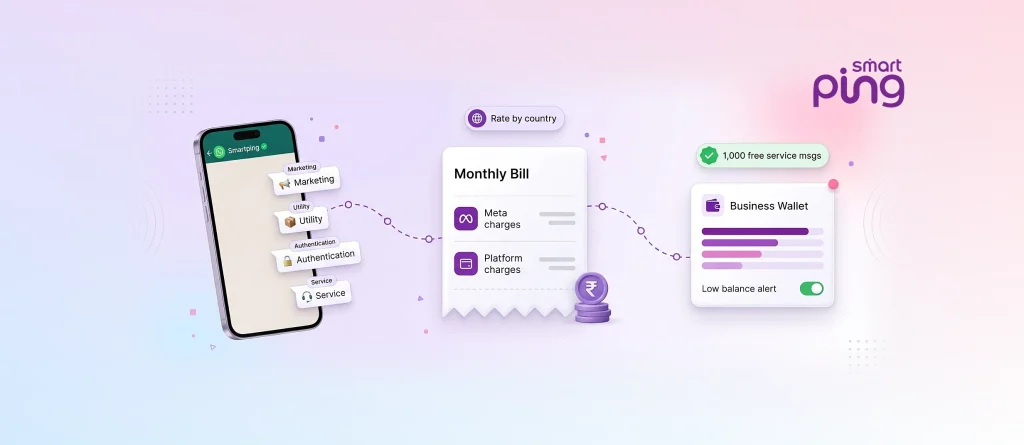
Table of Contents
- 1. What Does WhatsApp Business API Pricing Include?
- 2. How Does Meta Charge for Each WhatsApp Message?
- 3. WhatsApp Message Pricing by Category
- 4. Authentication-International Rates: Who Pays Them and When?
- 5. When Are WhatsApp Messages Free?
- 6. WhatsApp Cloud API Pricing: Is It Different?
- 7. What Drives Your Total WhatsApp Business API Cost?
- 8. WhatsApp API Cost in Practice: Four Industry Examples
- 9. Where Do WhatsApp API Costs Leak, and How Can You Control Them?
- 10. Billing Models: Pay As You Go, Prepaid Credits and Enterprise Plans
- 11. How Much Do WhatsApp Chatbots and Automation Cost?
- 12. How Should You Compare WhatsApp API Pricing Across Providers?
- 13. Why Does Smartping Offer Custom WhatsApp Business API Plans?
- 14. Get Your WhatsApp Business API Cost Estimate
- 15. Frequently Asked Questions
If you are planning WhatsApp Business API pricing into an enterprise budget, these two components make up the whole picture. The rest of this guide explains what moves each one, where costs quietly build up and how teams in fintech, retail, logistics and healthcare keep their spend predictable.
Key Takeaways
-
Two cost components: Meta charges for each delivered template message, and your BSP charges for the platform, automation, integrations and support around it.
-
Every message is billed by category: Since July 1, 2025, each delivered template message is charged on its own. Marketing has no volume tiers, while utility and authentication get cheaper as volume grows.
-
Some messages are free: Messages from customers, the first 1,000 service messages per number each month, and replies inside a 72-hour free entry point window.
-
Protect your OTP rate: A verified Indian primary business location keeps OTPs to Indian numbers on the standard authentication rate.
-
Most overspend is operational: Template drift, duplicate sends, disengaged contacts, chatty bots and spend without visibility cause most cost leaks.
What Does WhatsApp Business API Pricing Include?
Every line on a WhatsApp Business API invoice traces back to one of two sources, and separating them is the first step to controlling spend because the two behave very differently.
| Cost component | Who charges it | What drives it | How it is billed |
|---|---|---|---|
| Meta messaging charges | Meta | Message category, recipient country, monthly volume tier | Per delivered template message |
| Provider (BSP) charges | Your BSP, such as Smartping | Platform access, automation, integrations, users, numbers, support level | Platform plan, usage or custom enterprise agreement |
Meta’s side standardized any business sending a utility message to an Indian number that is billed from the same rate card, and Meta revises its rate cards only at the start of a quarter. The provider side is where businesses differ. A lending app that only needs a secure OTP flow uses far less tooling than a retail brand running catalog campaigns, cart recovery and live-agent support at the same time, so even at similar message volumes, their platform costs will look quite different.
How Does Meta Charge for Each WhatsApp Message?
Meta’s side of the bill follows a per-message model, and three factors set the rate for each message you send.
Per-message pricing replaced conversation-based pricing
The Meta half of WhatsApp Business API pricing changed considerably in 2025. Until July 1, 2025, Meta billed per 24-hour conversation, so a single charge covered every template message sent within that window. That model is now deprecated, and under per-message pricing each delivered template message is charged on its own, while a message that is never delivered is never charged.
This shift changed how enterprises should budget. A four-step shipping sequence (order confirmed, packed, shipped, out for delivery) once fitted inside a single conversation charge, but today each of those four messages is billed separately. The unit to plan around is therefore no longer the conversation; it is the WhatsApp API cost per message, multiplied by the number of messages your journeys actually send.
What sets the WhatsApp API cost per message?
Three factors decide the rate for any message. The category sets the base rate, and the recipient’s country calling code decides which market’s rate card applies, so a message to a +91 number is billed at India rates. For utility and authentication messages, monthly volume decides the tier: the more you send in a market, the lower the per-message rate. Meta counts that volume across every WhatsApp Business Account in your business portfolio, which matters for groups that run a separate account for each brand. Marketing and service messages, by contrast, have no volume tiers.
WhatsApp Message Pricing by Category
The table below summarises how each category is treated under Meta’s current WhatsApp Business API pricing model, and the sections that follow explain the cost implications of each one.
| Category | Typical business use | Volume tiers | Billing inside an open customer service window |
|---|---|---|---|
| Marketing | Offers, launches, cart recovery, re-engagement | No | Charged |
| Utility | Order, payment, delivery and appointment updates | Yes | Charged since October 1, 2026 |
| Authentication | OTPs, login verification, account recovery | Yes | Charged |
| Service | Free-form replies to customer queries | No | Free up to 1,000 per business phone number each month, then charged |
Marketing messages
Marketing templates carry promotional intent and cover festive offers, product launches, abandoned cart reminders and win-back campaigns. Every delivered marketing message is charged with no volume tiers, and in most markets marketing is the highest-priced category, which makes it the line that moves the monthly bill the most for campaign-led businesses.
For high-volume sends, Meta’s Marketing Messages API (MM Lite) adds delivery optimisation, and according to Meta’s documentation, businesses using it can set a maximum price per marketing message delivery. This gives marketing teams a fixed ceiling to plan against during peak seasons.
Utility messages
Utility templates are transactional updates tied to something the customer did, such as an order confirmation, a payment receipt, a shipment alert or an appointment reminder. Because they qualify for volume tiers, they are economical for operations-heavy businesses. One recent change is worth flagging here: utility templates sent inside an open customer service window were free from July 1, 2025, but Meta has charged for them since October 1, 2026.
Categorisation is where most unplanned utility costs come from. If a delivery update includes a discount code for the next purchase, Meta treats the template as marketing and bills it at the marketing rate. Meta can also recategorise a template after approval, and the charge always follows the category applied at the time of sending, so keeping transactional templates strictly transactional is one of the simplest cost controls available.
Authentication messages (OTP)
Authentication templates deliver one-time passwords for login, transaction verification and account recovery. Since they qualify for volume tiers, the cost per OTP falls as monthly volume grows, and for BFSI, fintech and large consumer platforms that send OTPs in the lakhs every month, the tier they reach has a direct effect on WhatsApp OTP pricing.
Service messages
Service messages are free-form replies sent while a customer service window is open, whether a support agent or a third-party chatbot sends them. Since October 1, 2026, each business phone number receives 1,000 delivered service messages free every month, and every service message beyond that is charged. Unused free messages do not carry over to the next month, and service messages have no volume tiers.
For a support team handling thousands of customer queries a month on a single number, this changes the economics of WhatsApp support, because replies that cost nothing in 2025 now count toward the bill once the free tier is used up.
Authentication-International Rates: Who Pays Them and When?
OTP billing across borders is the least understood part of WhatsApp Business API pricing in India. Meta applies a separate, higher authentication-international rate to OTPs delivered in a defined list of markets, India among them. This rate is published on Meta’s rate card and replaces the standard authentication rate only when all three of the following conditions are true:
-
Your business is eligible: A business becomes eligible after it sends more than 750,000 messages outside customer service windows in a moving 30-day period, counted across all its WhatsApp Business Accounts. Once triggered, eligibility is permanent.
-
The start time for that country has passed: Meta sets the start time 30 days after it determines eligibility and notifies the business by email and through an account_update webhook, which lists the start times and the primary business location on record.
-
Your business is based in another country: The rate applies to authentication messages sent to users in a listed country when the business’s primary business location is outside that country. OTPs to users in your own primary location are billed at the domestic authentication rate.
What This Means for Indian Businesses
A company whose verified primary business location is India pays the standard authentication rate on OTPs to Indian numbers, even after crossing the eligibility threshold. The risk lies in verification: if the primary business location is not verified and a country’s start time has passed, Meta bills OTPs to that country at the authentication-international rate. Verification in Meta Business Manager can take up to three business days and returns one of three outcomes: Verified, Need more information or Rejected.
Who Should Plan for the Authentication-international Rate?
An Indian fintech company that also serves users in other listed markets, such as the UAE or Indonesia, will pay the authentication-international rate on OTPs to those users once it becomes eligible. The same applies to a global platform headquartered outside India that sends OTPs to Indian customers. Because Meta sets this rate per market on its rate card, Smartping includes the applicable authentication rates in each custom estimate rather than quoting a single figure.
When Are WhatsApp Messages Free?
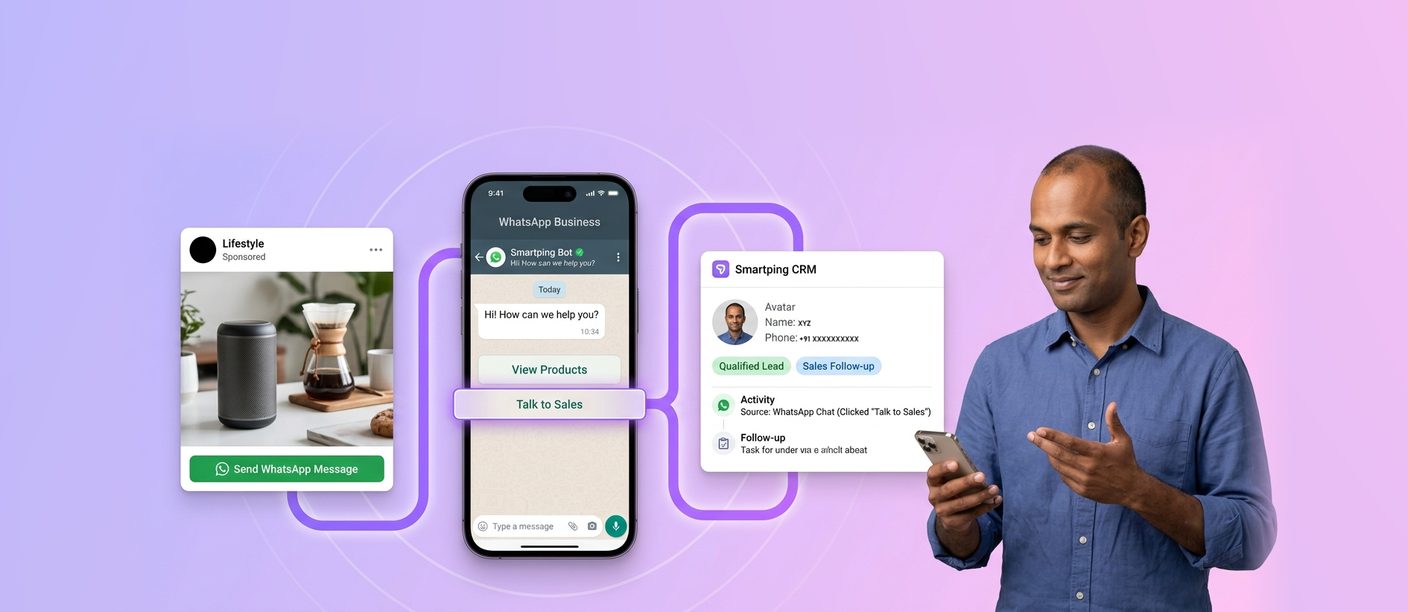
Free messages are an often overlooked part of WhatsApp Business API pricing, and three situations carry no Meta charge at all. Messages your customers send to you are always free, and the first 1,000 service messages per business phone number each month are free as well. In addition, when a customer starts a chat from a Click-to-WhatsApp ad or a Facebook Page call-to-action button and you reply within 24 hours, a free entry point window opens for 72 hours, during which the messages you send are not charged.
That third window is one of the most underused savings available. Brands that route acquisition through Click-to-WhatsApp ads can run a complete first-touch sequence (welcome, catalog, follow-up) inside those 72 hours without paying messaging charges. Our WhatsApp ads guide explains how to plan follow-ups within this window.
WhatsApp Cloud API Pricing: Is It Different?
No. Since Meta retired the self-hosted On-Premises API on October 23, 2025, WhatsApp Cloud API pricing and WhatsApp Business API pricing describe the same per-message model, and the rates apply in the same way whether you connect to the Cloud API directly or through a provider. Our WhatsApp Cloud API explainer covers how the architecture works.
The difference lies in the work around it. A business integrating directly has to build and maintain its own campaign tooling, shared inbox, template management, webhooks, reporting and billing reconciliation. A BSP, on the other hand, handles onboarding, business verification, number provisioning, template approval support and compliance, and provides that tooling as a ready platform. The BSP charge on your invoice pays for this layer.
What Drives Your Total WhatsApp Business API Cost?
Once Meta’s model is clear, the total WhatsApp Business API cost for an enterprise comes down to a handful of variables. Listed in order of impact for most of the businesses we work with, they are:
| Cost driver | Why it matters |
|---|---|
| Category mix | A business sending mostly utility alerts and OTPs has a very different cost profile from one running weekly promotional broadcasts. |
| Monthly volume | Decide your tier for utility and authentication, and how quickly support teams exhaust the service free tier. |
| Destination countries | Each recipient country is billed from its own rate card. |
| Automation depth | Guided flows, AI chatbots and AI agents carry different build and usage costs. |
| Integrations | CRM, ERP, payment gateway and contact centre connections add setup and maintenance effort. |
| Support and SLA | Dedicated account management and response-time commitments are priced into the platform side. |
WhatsApp API Cost in Practice: Four Industry Examples
The same WhatsApp Business API pricing model produces very different bills depending on the business. The four scenarios below show where the WhatsApp Business API cost sits for each type of business and which lever lowers its effective WhatsApp API cost per message.
Fintech lending app: authentication-heavy
Most of a lending app’s WhatsApp traffic consists of OTPs for login and loan disbursal, followed by utility reminders for EMI due dates and a small volume of marketing for pre-approved offers. The biggest lever here is OTP efficiency. Resend cooldowns, one-tap or copy-code buttons and clear expiry messaging reduce repeat OTP requests, while SMS is kept as a fallback for failed deliveries rather than sent in parallel. A verified primary business location also keeps domestic OTPs on the standard authentication rate.
D2C Retail Brand: Marketing-Heavy
For a fashion or electronics brand, marketing messages spike during festive sales and end-of-season events, while utility messages track order volume. Since marketing has no volume tiers, the lever is sharper targeting rather than greater scale. Segmenting by recent engagement, suppressing contacts who have not read a message in months and using Click-to-WhatsApp ads to open free entry point windows all reduce the cost per conversion.
Logistics company: utility at scale
A courier or 3PL sends delivery status updates in high volume, which makes utility tiers valuable. Here, the lever is journey design: combining milestones into fewer, more informative updates and keeping every template free of promotional content prevents both message bloat and reclassification to marketing.
Multi-location hospital group: service-heavy
A hospital network uses WhatsApp for appointment booking, reports and patient queries, so most of its traffic is service replies. Because the free tier applies per business phone number, the way numbers are structured across locations has a direct effect on cost. WhatsApp Flows that collect booking details in one structured form also resolve requests in fewer messages than a long back-and-forth chat.
Where Do WhatsApp API Costs Leak, and How Can You Control Them?
In enterprise accounts, overspend rarely comes from WhatsApp Business API pricing itself. It usually comes from operational habits that nobody owns, and the five below are the ones we see most often.
Template Drift
When a marketing team edits a utility template to add an offer, Meta reclassifies the template as marketing. Assigning a single owner for template approvals and using controls such as Smartping’s Template Pause stops this from reaching production campaigns.
Duplicate Sends
Webhook retries, double-clicked OTP buttons and repeated API calls can trigger the same message more than once. Idempotency checks on the integration side, combined with resend cooldowns on OTP flows, remove most of this waste.
Messaging Disengaged Contacts
Marketing messages sent to users who have not opened a message in a long time are still charged on delivery, yet they rarely convert. Suppression lists based on read rates protect both your budget and your sender quality.
Chatty Automation
A bot that needs eight service replies to complete a task costs more than a WhatsApp Flow that completes it in two. Measuring the number of messages per resolved query shows where flows need to be redesigned.
Spend Without Visibility
Teams that only see a monthly total cannot tell which journey caused a spike. Tracking cost by category and by outcome, such as cost per verified login or cost per recovered cart, turns WhatsApp spend into a number that marketing and finance can manage together.
Billing Models: Pay As You Go, Prepaid Credits and Enterprise Plans
For most businesses, WhatsApp API pricing in India is usage-based, which is what teams usually mean by “WhatsApp API pay as you go”: you pay for the messages delivered rather than a flat fee for unlimited messaging. Providers typically package this in one of three ways:
-
Prepaid wallet: You recharge credits in advance, and each delivered message is deducted by category.
-
Platform plan plus usage: Tooling and support sit on a recurring charge, and messages are billed as they are sent.
-
Custom enterprise agreement: Billing structure, credit terms and support levels are set around your volumes.
Whichever model you choose, real-time visibility matters more than the model itself. A wallet that runs dry mid-campaign pauses delivery at the worst possible moment, so low-balance alerts and category-level usage dashboards should be part of any setup.
For Indian accounts, Meta introduced INR billing on January 1, 2026, and every eligible account must move to INR by December 31, 2026. If you work with a BSP, confirm that your billing has already made the switch.
How Much Do WhatsApp Chatbots and Automation Cost?
WhatsApp chatbot pricing depends on what powers the automation. Guided flows and rule-based bots for bookings, lead capture and FAQs mostly involve design and setup costs, and their replies count as service messages. Third-party AI chatbots built on NLU or LLM models typically add AI usage charges from the model provider on top of Meta’s service message charges, whereas Meta’s own Business Agent is a separate category that has been charged per token since August 1, 2026. Smartping’s Conversational AI supports AI chatbots with smart routing and handover to live agents.
Integration effort sits alongside these costs. The cost of connecting WhatsApp to your CRM, ERP or contact centre depends on whether ready connectors exist, how many event triggers you need and how delivery statuses flow back into reporting. Our WhatsApp developer guide covers the technical flow for engineering teams.
How Should You Compare WhatsApp API Pricing Across Providers?
A low headline rate can hide higher costs in setup, integration, support or failed deliveries. The questions below give you a more accurate comparison of WhatsApp API pricing between providers.
| Question to ask | Why it matters |
|---|---|
| Are Meta charges shown separately from the platform fee? | Transparent pass-through makes monthly reconciliation straightforward for finance teams. |
| What does the platform fee include? | Users, numbers, automation, integrations and support vary widely between plans. |
| Can we track spend by category in real time? | Category-level visibility is the only way to catch template drift and campaign overspend early. |
| How are template recategorisations handled? | Automatic pause controls prevent unplanned marketing charges. |
| Is this the official WhatsApp Business Platform? | Unofficial tools carry account ban and compliance risk. |
| Can it fall back to SMS or RCS? | One platform for fallback channels avoids managing multiple vendors. |
Why Does Smartping Offer Custom WhatsApp Business API Plans?
Fixed plans suit predictable, simple usage, and most enterprises have neither. A fintech’s OTP traffic, a retailer’s festive campaigns and a logistics firm’s delivery alerts differ completely in category mix, seasonal peaks and integration needs. That is why Smartping treats WhatsApp Business API pricing as a custom exercise, building each plan around the business’s actual message mix rather than a standard package.
As a Meta Business Partner, Smartping provides official WhatsApp Business API access with business verification, number provisioning and template approval support, all delivered through SPARC (Smart Platform for Automated Real-time Communication), our omnichannel platform for WhatsApp, SMS, voice and email. Cost controls are built into the platform. Template Pause stops campaigns if Meta reclassifies a utility template, while Marketing Messaging Opt-in pauses marketing sends with a single toggle and keeps OTPs and transactional messages flowing. The prepaid WhatsApp Business Wallet shows balance and usage by category in real time, and the MM Lite API, Conversion API, WhatsApp Flows, Native Payments and the WhatsApp Voice Calling API are available as your use cases grow.
Get Your WhatsApp Business API Cost Estimate
The most reliable way to understand WhatsApp Business API pricing for your business is to start from your own message mix. When you request an estimate, our team will ask for four details:
-
Expected monthly messages by category (marketing, utility, authentication, service)
-
The countries you send messages to
-
Systems you need to connect, such as your CRM, ERP or payment gateway
-
Your automation and support requirements
We map these details to Meta’s current rate card and the platform features you need, then share a custom estimate that shows Meta charges and platform charges separately, so your finance and marketing teams can see exactly what they are paying for. Have these numbers ready, click Get My Custom Estimate and our team will take it from there.
If you would like to see the platform before sharing your numbers, you can schedule a demo instead. Existing Smartping customers can log in to SPARC at any time to view usage and spend by category.
Frequently Asked Questions
How much does WhatsApp Business API cost for a business?
There is no single price. WhatsApp Business API pricing combines Meta’s per-message charges, which depend on category, recipient country and volume tier, with your provider’s charges for platform, automation, integrations and support. Smartping prepares a custom estimate based on your monthly message mix.
Is WhatsApp Business API pay as you go, or are there monthly charges?
WhatsApp API pricing from Meta is usage-based, so you pay per delivered message. A provider may add a recurring platform charge, bill purely on usage or agree to a custom enterprise structure, and Smartping sets the billing model as part of your custom plan.
Can we prepay for WhatsApp messages?
Yes. Smartping supports prepaid billing through the WhatsApp Business Wallet, where you recharge credits in advance, each delivered message is deducted by category, and balance and usage are visible in real time.
What decides the WhatsApp API cost per message?
Three factors decide it: the message category (marketing, utility, authentication or service), the country calling code of the recipient’s number and, for utility and authentication, the monthly volume tier your business portfolio reaches. Only delivered messages are charged.
How does utility message cost compare with marketing message cost?
Marketing is generally the highest-priced category and has no volume tiers. Utility messages cover transactional updates linked to a customer action and qualify for volume tiers, although a utility template that includes promotional content is billed as marketing.
Who pays the authentication-international rate?
Only businesses that meet three conditions: they have sent more than 750,000 messages outside customer service windows in a moving 30-day period, the recipient country’s start time has passed, and their primary business location is outside the recipient’s country. Indian businesses with a verified Indian location pay the standard rate on OTPs to Indian numbers.
Are WhatsApp service messages still free?
Only partly. Since October 1, 2026, each business phone number gets 1,000 free service messages per month, after which service messages are charged. Inbound messages from customers remain free, and messages sent inside a 72-hour free entry point window are not charged either.
Is WhatsApp Cloud API pricing different from WhatsApp Business API pricing?
No. Since the On-Premises API was retired on October 23, 2025, the Cloud API is the WhatsApp Business API, and the same per-message model applies whether you integrate directly or through a BSP.
Is there a minimum package for low message volumes?
The WhatsApp Business API has no minimum company size or message volume requirement, and per-message billing means low-volume businesses pay only for what they deliver. Smartping sizes plan to your current volume, with room to scale as you grow.
What affects WhatsApp Business API pricing in India?
WhatsApp Business API pricing in India depends on the India rate for each category, your category mix, volume tiers for utility and authentication, the service free tier per number, applicable GST and, for OTPs, the status of your primary business location. Eligible Indian accounts must also move to INR billing by December 31, 2026.
Enable businesses to forge enduring connections with their customers through multiple channels.
Table of Contents
- 1. What Does WhatsApp Business API Pricing Include?
- 2. How Does Meta Charge for Each WhatsApp Message?
- 3. WhatsApp Message Pricing by Category
- 4. Authentication-International Rates: Who Pays Them and When?
- 5. When Are WhatsApp Messages Free?
- 6. WhatsApp Cloud API Pricing: Is It Different?
- 7. What Drives Your Total WhatsApp Business API Cost?
- 8. WhatsApp API Cost in Practice: Four Industry Examples
- 9. Where Do WhatsApp API Costs Leak, and How Can You Control Them?
- 10. Billing Models: Pay As You Go, Prepaid Credits and Enterprise Plans
- 11. How Much Do WhatsApp Chatbots and Automation Cost?
- 12. How Should You Compare WhatsApp API Pricing Across Providers?
- 13. Why Does Smartping Offer Custom WhatsApp Business API Plans?
- 14. Get Your WhatsApp Business API Cost Estimate
- 15. Frequently Asked Questions
Latest Blogs
-
WhatsApp Business Calling API for Complex Support Queries
WhatsApp Business API Flows are interactive, multi-screen forms that customers can open, complete, and submit without leaving a WhatsApp conversation....
Read More
-
WhatsApp Business API Provider in India: 10 Questions to Ask
10 Questions to Ask a WhatsApp Business API Provider in India Before You Sign A WhatsApp Business API provider in...
Read More
-
Smartping at World AI Summit 2026: AI Voicebot and WhatsApp AI Chatbots for Enterprises
Bengaluru, 21 October 2026: Smartping, a Meta Business Partner and enterprise communication platform, showcased its AI Voicebot and WhatsApp AI...
Read More
Share


Related Blogs & Articles
WhatsApp Business Calling API for Complex Support Queries
WhatsApp Business API Flows are interactive, multi-screen forms that customers can open, complete, and submit without leaving a WhatsApp conversation....

WhatsApp Business API Provider in India: 10 Questions to Ask
10 Questions to Ask a WhatsApp Business API Provider in India Before You Sign A WhatsApp Business API provider in...
Smartping at World AI Summit 2026: AI Voicebot and WhatsApp AI Chatbots for Enterprises
Bengaluru, 21 October 2026: Smartping, a Meta Business Partner and enterprise communication platform, showcased its AI Voicebot and WhatsApp AI...
WhatsApp Ads Guide: How to Run Click-to-WhatsApp Campaigns in Ads Manager and Convert Chats into Leads
WhatsApp ads are Click-to-WhatsApp ads: Facebook and Instagram ads with a “Send WhatsApp Message” button that opens a chat with...
How to Send Messages with the WhatsApp API: Templates, the 24-Hour Window and Interactive Messages
To send a message with the WhatsApp API, your system sends a request to Meta’s Cloud API specifying the recipient,...
WhatsApp Business Marketing at Enterprise Scale: From Broadcasts to Customer Engagement
WhatsApp Business marketing at enterprise scale means using the official WhatsApp Business Platform to run personalised, permission-based campaigns and two-way...




 First Floor, Unit F-49, Sector-47, Spaze Boulevard, Gurugram, Haryana 122018