India
India
 Singapore
Enterprise Voice Solutions in India: The Complete Guide to Trusted Business Calling
-
 By Smartping
- Oct 01, 2026
- Voice
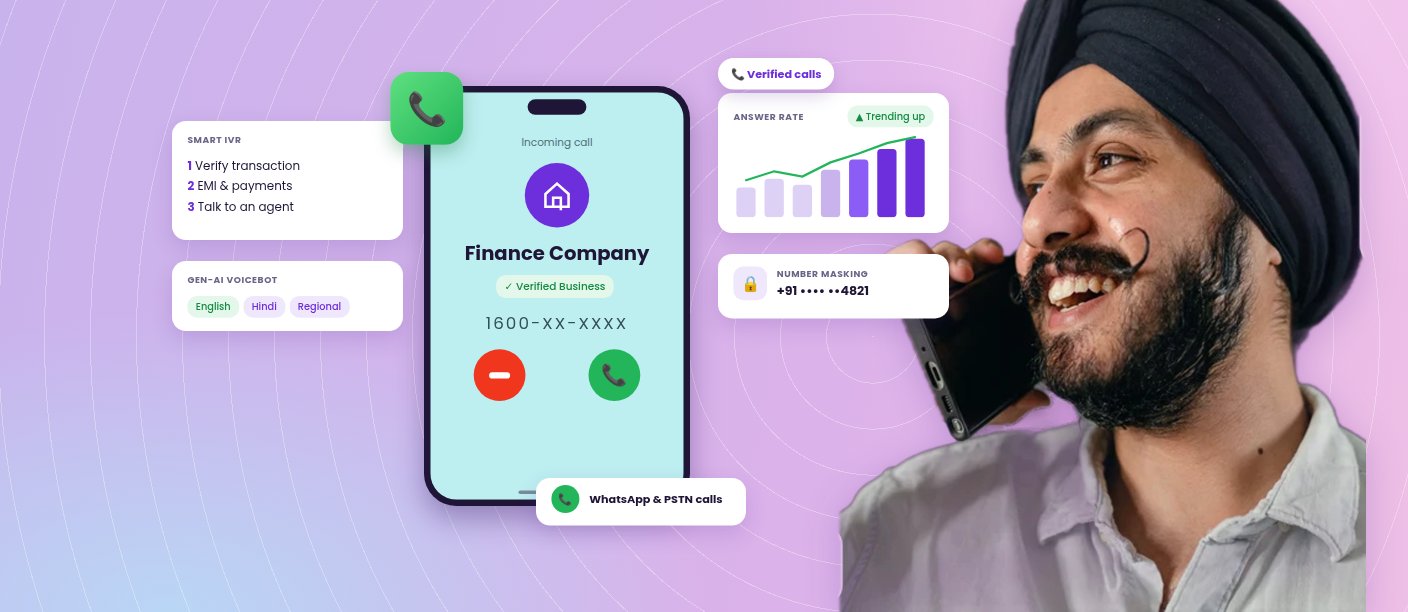
Enterprise voice covers every call an organisation makes to or receives from its customers: service helplines, verification calls, payment reminders, appointment confirmations, citizen alerts and sales conversations. It remains the channel customers rely on when a matter is urgent, sensitive or complex.
In India, enterprise voice is undergoing a structural change. The 1600 number series, Calling Name Presentation (CNAP) and generative AI have redefined how business calls are identified, delivered and handled. For enterprises operating at scale, these developments create both a compliance obligation and an opportunity to improve answer rates and resolution.
This guide sets out the enterprise voice toolkit, India’s verified calling framework, outbound calling compliance, the role of AI in voice conversations, industry use cases, peak planning and the metrics that indicate performance.
Enterprise Voice in 2026: Verified, Automated and Measurable
Three shifts define enterprise voice today.
First, identity. Regulatory measures now allow customers to recognise a business call before answering. Second, automation. Generative AI handles complete conversations, not just menu navigation. Third, measurement. Cloud platforms record, transcribe and analyse conversations at scale, turning voice into a source of operational insight.
Together, these shifts make enterprise voice a managed, measurable part of customer experience rather than a purely operational function.
The Shift From On-Premise PBX to Cloud Telephony
Traditional on-premise PBX systems require hardware, long deployment cycles and physical infrastructure. Cloud telephony delivers voice capabilities through the cloud, with several operational advantages:
1. Deployment speed: Numbers, IVR flows and teams can be configured in days.
2. Elastic capacity: Capacity expands and contracts with call volumes, including seasonal peaks.
3. Distributed teams: Agents can operate from offices, branches or home.
4. System integration: Calls connect with CRMs, ticketing systems and analytics platforms.
Inbound, Outbound and Automated Voice
Enterprise voice operates in three modes. Inbound voice handles calls customers make to the business through helplines, IVR and routing. Outbound voice covers calls the business makes to customers, such as verifications, reminders and service updates. Automated voice uses pre-recorded messages, broadcasts and AI voicebots to conduct conversations without an agent on every call.
Most enterprises operate all three. The objective is to manage them as one connected system with shared customer context.
The Enterprise Voice Toolkit
IVR and Multi-Level Call Routing
Interactive Voice Response (IVR) greets callers, identifies their requirement and routes them to the right team. Multi-level IVR supports organisations with multiple departments, languages and service lines. Well-designed IVR reduces transfers, shortens wait times and resolves routine queries without agent involvement.
Outbound Dialling and Voice Broadcast (OBD)
Outbound dialling and voice broadcasts deliver personalised automated calls at scale. Enterprises use them for payment reminders, appointment confirmations, service alerts and public announcements, with options for the customer to respond or be transferred to a live agent.
Click-to-Call and Missed Call Services
Click-to-call allows customers to request a call from a website, app or campaign with a single action. Missed call services allow customers to register interest, confirm an action or request a callback by dialling a number. Both reduce friction at the first step of a conversation.
Number Masking for Privacy
Number masking connects two parties, such as a delivery partner and a customer, without revealing either phone number. It protects personal data while keeping the conversation possible, and is widely used in logistics, marketplaces, mobility and healthcare.
Call Recording and Voice Logger
Call recording captures conversations for quality assurance, training, dispute resolution and compliance. A voice logger makes recordings searchable and retrievable, so teams can locate a specific conversation quickly when it is required.
Verified Calling in India: The 1600 Series and CNAP
India has introduced two measures that change how customers identify business calls.
The 1600 Series for BFSI
TRAI has mandated the 1600 number series for service and transactional calls made by entities regulated by RBI, SEBI, PFRDA and IRDAI. Migration deadlines were phased between January and March 2026.
When a customer sees a call from a 1600-series number, they can identify it as a call from a regulated financial institution. For banks, NBFCs, insurers, brokers and asset managers, this requires reorganising calling operations around the new series, updating customer communication and monitoring answer rates after migration.
CNAP: Verified Caller Names on Every Call
Calling Name Presentation (CNAP), approved by TRAI in 2025, displays the caller’s verified name on the recipient’s screen, drawn from KYC-verified subscriber records.
For enterprises, this means the business name appears alongside the number when they call. Customers gain a reliable signal of authenticity, and impersonation becomes considerably harder.
The Impact on Answer Rates and Customer Trust
Verified numbers and names address the principal reason customers ignore business calls: uncertainty about the caller. Enterprises should track answer rates, callback rates and complaint volumes before and after adopting verified calling, to quantify the effect on customer experience and operational efficiency.
Outbound Calling Compliance Under TRAI
DND Scrubbing and Consent Records
Before placing promotional calls, enterprises must check numbers against customer preferences and consent records. DND scrubbing removes numbers that have opted out of specific categories of communication. Consent records must be maintained and auditable, with a clear link between each call and the consent that permits it.
AI Callers Follow the Same Rules as Human Agents
TRAI draws no distinction between a call placed by a human agent and one placed by an AI voicebot. Automated and AI-led calls must follow the same requirements on consent, calling hours, number series and disclosure. Enterprises deploying voice AI should build these controls into call logic from the outset.
AI in Enterprise Voice: From IVR Menus to Gen-AI Voicebots
Intent-Based Routing
Traditional IVR asks customers to navigate menus. AI-enabled systems ask the caller to state their requirement, interpret the intent and route the call to the right team or resolve it directly. This shortens call duration and reduces misrouted calls.
Multilingual Voicebots and Language Switching
Customers in India frequently switch between languages within a single conversation. Gen-AI voicebots detect the caller’s language and switch automatically across Hindi, English, Hinglish and regional languages, allowing automated conversations to remain natural.
Human Handoff With Full Context
AI voicebots handle routine and high-volume conversations such as order status, appointment booking and payment reminders. When a conversation requires human judgement, the call transfers with full context, so the customer does not repeat information already provided.
Voice Across Networks: PSTN and WhatsApp Calling
Customers now reach businesses both through the phone network and from within WhatsApp. The WhatsApp Business Calling API supports calls with recording and transcription.
For enterprises, the objective is one consistent experience: calls from both networks routed into the same queues, recorded and analysed in the same way, and linked to the same customer history.
Enterprise Voice Use Cases Across Industries
BFSI and Fintech
Transaction verification, fraud alerts, KYC follow-ups and EMI reminders, now conducted on verified number series with displayed caller identity.
Logistics and E-commerce
Number masking for delivery coordination, automated confirmation calls and voicebots for order status queries, with automation absorbing peak volumes.
Healthcare
Appointment confirmations, report notifications and post-treatment follow-ups, supported by multilingual voicebots for patients across regions.
Automotive, Real Estate and EdTech
Test-drive and service booking confirmations, site-visit scheduling, enquiry follow-ups and admission counselling, where response speed directly affects conversion.
Government
Voice broadcasts for citizen alerts, scheme awareness and emergency communication, delivered in multiple regional languages.
Planning for Peak Call Volumes
Festive seasons, sale events, admission cycles and renewal periods create sharp spikes in call volume. Voice infrastructure should be prepared before the peak.
Concurrency, Capacity and Queue Design
Enterprises should forecast concurrent call volumes rather than daily totals alone. Queue design, including wait thresholds, callback options and priority rules, determines whether customers experience a short wait or abandon the call.
Overflow Handling and Backup Agents
When primary teams reach capacity, overflow rules route calls to backup agents, alternate locations or automated handling. Voicebots resolve routine queries during spikes, keeping agents available for complex conversations.
Governance: Recording, Retention and Data Protection
Voice conversations contain personal and financial information. Under the DPDP Act, enterprises must inform customers about recording, define the purpose of processing, set retention periods, control access and secure storage. With the Consent Manager framework operational from 13 November 2026 and full compliance required from 13 May 2027, recording notices and retention policies should be reviewed now.
Measuring Voice Performance
Measuring voice performance helps enterprises understand how effectively their calling infrastructure handles customer interactions. Key performance metrics provide insights into call connectivity, service efficiency, automation and customer experience.
1. Answer rate: The percentage of outbound calls answered.
2. Abandonment rate: The percentage of inbound callers who disconnect before reaching help.
3. Average handling time (AHT): The time taken to resolve a call.
4. First-call resolution (FCR): The percentage of issues resolved in a single call.
5. Automation rate: The share of calls resolved by IVR or voicebots without an agent.
6. Customer satisfaction: Post-call feedback and sentiment trends from speech analytics.
Integration With Enterprise Systems
Voice delivers its full value when it is connected to the systems that hold customer data. Integration with CRMs, ticketing platforms, core banking systems, order management and collection platforms allows calls to be initiated from within business workflows and outcomes to be written back automatically.
Practical integration points include screen pops that present customer context as the call connects, click-to-call from within the CRM record, automatic logging of call outcomes and dispositions, callback scheduling based on system events such as a failed payment or a pending renewal, and transfer of call recordings and transcripts to the customer record for audit purposes.
APIs also allow voice events to trigger action elsewhere. A completed verification call can update an application status. An unanswered reminder call can schedule a follow-up through another channel. Designing these connections during implementation, rather than after go-live, avoids manual work and keeps records accurate.
Implementation Roadmap
Enterprise voice deployments follow a predictable sequence. Requirements are defined by use case, call type and team. Numbering and compliance requirements, including the 1600 series where applicable, are confirmed with the provider. IVR flows, routing rules and scripts are designed and reviewed. Integrations are configured and tested with sample data. A pilot runs with a limited team or queue, with monitoring of answer rates, handling time and call quality. Findings from the pilot are applied before wider rollout, and reporting is established so performance is visible from the first week of operation.
Choosing an Enterprise Voice Provider: An Evaluation Checklist
Choosing an enterprise voice provider requires evaluating more than just calling features. Enterprises should consider compliance, reliability, technology, integrations, scalability, analytics and ongoing support to ensure the voice infrastructure can meet operational and customer communication requirements.
1. Compliance support: 1600 series enablement, DND scrubbing and consent management.
2. Reliability: Uptime commitments and carrier-grade infrastructure.
3. Complete toolkit: IVR, OBD, click-to-call, missed call, masking and recording.
4. AI readiness: Gen-AI voicebots with multilingual capability and context-rich handoff.
5. Integrations: CRM and helpdesk connectors, plus open APIs.
6. Scalability: Proven performance during peak volumes.
7. Analytics: Real-time dashboards and conversation insights.
8. Support: Accountable service with defined SLAs.
Enterprise Voice With Smartping
Smartping helps enterprises build voice operations that customers trust and teams can scale.
Smartping’s voice suite brings together IVR and multi-level routing, outbound dialling and voice broadcasts, click-to-call, missed call services, number masking and call recording within one platform. For BFSI enterprises, Smartping supports migration to the 1600 series. Its Gen-AI voicebot conducts natural conversations in 10+ languages, switches language automatically and transfers to agents with full context.
Through SPARC, voice operates alongside SMS, WhatsApp, RCS and email, so every conversation forms part of one connected customer journey.
Schedule a demo at smartping.ai to see how Smartping can support your enterprise voice operations.
Frequently Asked Questions
1. Is the 1600 series mandatory for all financial institutions?
The mandate applies to service and transactional calls from entities regulated by RBI, SEBI, PFRDA and IRDAI, including banks, NBFCs, insurers, brokers and pension fund entities. Deadlines were phased between January and March 2026.
2. Can AI voicebots place outbound calls in India?
Yes. AI voicebots can place outbound calls, and TRAI applies the same rules to AI callers as to human agents, including consent, DND preferences, permitted calling hours and approved number series.
3. Can cloud telephony integrate with an existing CRM?
Yes. Cloud telephony platforms integrate with CRMs through native connectors and APIs, providing customer context to agents, logging calls automatically and enabling click-to-call from within the CRM.
4. Is call recording permitted under Indian data privacy law?
Call recording is permitted when customers are informed and recordings are handled in line with the DPDP Act, including defined purpose, retention periods, access controls and secure storage.
5. Can one platform run inbound support and outbound campaigns together?
Yes. A unified voice platform manages inbound and outbound calling from one system, using separate number ranges, routing rules and compliance controls for each type of call.
Enable businesses to forge enduring connections with their customers through multiple channels.
Latest Blogs
-
Cloud Contact Center Solutions: The Complete Guide for Indian Enterprises
A cloud contact center, also described as Contact Center as a Service (CCaaS), delivers customer interaction management through the cloud:...
Read More
-
RCS Business Messaging in India: The Complete Enterprise Guide for 2026
Rich Communication Services (RCS) is the messaging standard that brings branded, interactive experiences to the native messaging inbox on a...
Read More
-
Enterprise SMS in India: The Complete Guide to Reliable, Compliant Messaging at Scale
Enterprise SMS is the messaging layer behind India's most critical customer communication. Payment confirmations, one-time passwords, account alerts, delivery updates...
Read More

Share


Related Blogs & Articles
Cloud Contact Center Solutions: The Complete Guide for Indian Enterprises
A cloud contact center, also described as Contact Center as a Service (CCaaS), delivers customer interaction management through the cloud:...
RCS Business Messaging in India: The Complete Enterprise Guide for 2026
Rich Communication Services (RCS) is the messaging standard that brings branded, interactive experiences to the native messaging inbox on a...
Enterprise SMS in India: The Complete Guide to Reliable, Compliant Messaging at Scale
Enterprise SMS is the messaging layer behind India's most critical customer communication. Payment confirmations, one-time passwords, account alerts, delivery updates...

WhatsApp Business API: A Complete Guide for Enterprises
Customer interactions rarely stay on one channel. A customer discovers a product through an ad, evaluates it on a website,...

One Channel, Complete Customer Journey: How WhatsApp Business API Improves Engagement and Drives ROI
Most enterprises handle customer interactions across multiple channels. A customer might discover your product through a click-through ad on one...




 First Floor, Unit F-49, Sector-47, Spaze Boulevard, Gurugram, Haryana 122018